
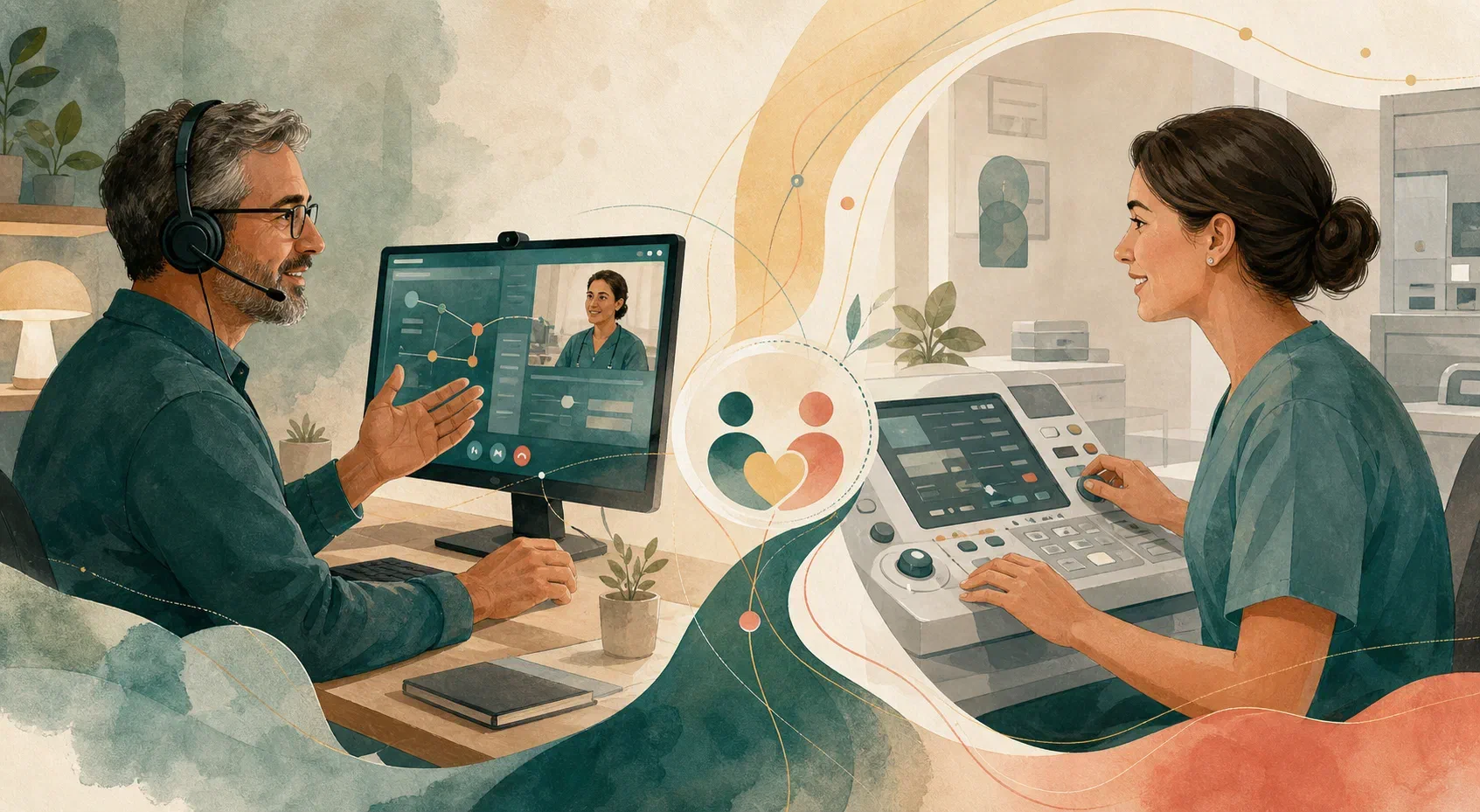

When we hear “remote operation,” distance may be the first thing that comes to mind. In practice, its value lies in the opposite movement: bringing knowledge and need closer together, even when they are not in the same place.
In radiology, this can expand access to specialized professionals, make schedules more flexible, and support facilities whose demand changes throughout the day.
Reading remotely and operating remotely are not the same thing
Teleradiology is already routine in many services: the exam is performed at the facility, the images travel to the archive, and a physician interprets them from wherever they are, sometimes hours later. What travels is the result.
Operating remotely is something else. Here the professional follows the exam while it happens: choosing the protocol, adjusting parameters, planning the slices, looking at the first sequence, and deciding whether it is worth repeating. What travels is the decision, and it has to arrive before the patient leaves the room.
That difference in timing changes everything downstream. A report can wait for the connection to improve. An acquisition cannot. If the remote professional loses a few seconds between seeing an image and reacting to it, the patient stays on the table meanwhile, and the window to correct poor positioning or repeat a sequence with an artifact closes.
Someone is still in the room
Remote operation does not empty the facility. Much of the exam is physical and continues to be done by whoever is present: receiving the patient, running the safety check before entering the room, positioning the person on the table, placing the coils, establishing intravenous access when contrast is used, staying with anyone who feels unwell.
In MRI, screening for ferromagnetic objects is the clearest example. No remote verification replaces an in-person check of implants, prostheses, jewelry, and objects in pockets, because the consequence of a mistake there is immediate and physical.
What remote operation redistributes is not presence but technical knowledge about the acquisition. The local team stays with the patient; decisions about protocol and parameters can come from whoever has the most experience with that kind of exam, wherever they are.
Connection is more than access
A reliable technical connection is essential, but it cannot solve everything alone. The experience also depends on shared context, clear communication, and well-defined responsibilities.
A healthy remote operation considers:
- how the local team requests and receives support;
- what information must accompany each situation;
- how professionals confirm they are seeing the same scenario;
- what happens when an exception arises;
- how lessons learned become part of the workflow.
These elements turn a remote session into real collaboration.
What the connection has to deliver
Three requirements come together, and none of them is optional.
A response fast enough for fine adjustment. Planning slices over a localizer is a continuous gesture: drag, look, correct. When there is a noticeable delay between the command and what appears on screen, the professional starts working in discrete steps, waiting for the image to confirm each movement. It works, but it is tiring and it consumes room time.
Enough fidelity to read the console. The remote screen does not need diagnostic workstation quality, because the report is not produced there. But it does need to show parameter values, safety indicators, and the artifacts that justify repeating a sequence without ambiguity. Compression that blurs a number or erases a subtle noise pattern turns the screen into an obstacle.
A closed path. Traffic travels through an isolated network, encrypted in transit, with more than one authentication step and a record of who accessed what and when. This is not bureaucracy: it is what allows reconstructing later what happened during an exam, and it is what separates legitimate remote access from remote access in general.
Trust is built in the details
Low latency, resolution, and stability form the technical foundation. Trust also grows from human signals: knowing who is on the other side, receiving a clear response, and feeling that someone is following the process.
Presence is not only physical proximity. It is the certainty that attention, responsibility, and availability are shared.
Communication built into the environment itself helps more than it seems. When voice, text, and image live in the same place where the exam happens, nobody has to switch between applications to report that the patient moved or that the next sequence has changed.
A plan for when things do not go as expected
Every remote operation has to answer one question before the first session: who stops the exam, and how.
The answer that holds up everything else is simple and should have no exception — the local team can always stop. If the patient calls out, if something looks wrong, if the connection drops mid-acquisition, the decision to end it cannot depend on someone who is far away.
From there, the rest deserves the same clarity. What happens to the sequence in progress when the connection is lost. Who takes over if the remote professional goes offline. How the patient is told about a pause, so waiting does not turn into anxiety. Where events are recorded, so the conversation afterwards does not depend on memory.
Agreeing on this beforehand costs one meeting. Discovering it in the middle of an exam costs considerably more.
What scale changes, and what should not change
Remote operation makes it possible to cover hours that used to go uncovered, to support smaller facilities with expertise they could not sustain on their own, and to place an experienced professional beside someone who is starting out — even when that “beside” is a screen.
That last point is the most underrated. A supervised session is also a learning session: the local team sees decisions being made, asks why a parameter changed, and carries that into the following exams. Over time, dependence on remote support decreases rather than grows.
There is a mirrored risk, and it deserves to be named. If remote operation is read as permission to reduce on-site staffing below what is needed, it stops expanding capacity and starts transferring load to people who are already stretched at the point of care. The technology distributes knowledge; it does not replace the hands that are with the patient.
A more flexible care network
When designed well, remote operation does not replace relationships. It creates new ways to sustain them.
The result can be a network that distributes expertise more effectively, responds faster, and supports teams without leaving them alone. Distance remains on the map, but it no longer defines the quality of collaboration.